

The honest comparison
Klue was built around competitor monitoring — tracking what rivals are doing publicly and helping teams build battlecards. That was a real differentiator before LLMs. Now any team can get that same data for free using Claude, ChatGPT, or Hindsight.
The intelligence that actually moves win rates isn't online. It's in your deals. What buyers said. What drove their decisions. What messaging actually worked in the field. Klue doesn't have that data. Hindsight does.
Quick comparison
| Hindsight | Klue | |
|---|---|---|
| External competitor monitoring | Yes, web, G2, news, job postings | Yes, web, G2, news, job postings |
| Deal outcome analysis | Every closed deal, verified | Limited, Gong call quotes only |
| Win-loss program | Automated, 100% deal coverage | Seller-only chat surveys, no buyer interviews |
| Battlecard source | What won and lost real deals | Web scraping and Gong call quotes |
| Buyer interview volume | Automated at scale, included | Minimal — we've done more interviews this month than Klue has in the last year |
| Deal-level analysis | Every closed deal, enriched | Reads back Gong/CRM data, no actual analysis |
| Time to insight | 48 hours post-close | Weeks to months for win-loss |
| AI-ready data | Verified deal records via API and MCP | No |
| Best for | Teams who want CI and win-loss in one verified platform | Teams who want managed CI with some win-loss services |
The half that matters most
Public competitor data is a commodity. Your competitors' websites, G2 reviews, job postings, pricing pages. Any PMM with Claude or ChatGPT can monitor all of that today for free — and so can your competitors. Paying a platform to scrape the same sites everyone else is watching doesn't give you an edge.
What nobody else has is your deal data. What your buyers actually said. What drove them to choose a competitor in your last 30 losses. What messaging worked in the field versus what just sounded good in the boardroom.
That data doesn't live online. It doesn't live in your Gong calls. Real insight requires asking buyers directly — and doing it at scale, on every deal, not just the ones an analyst had time to review.
Hindsight
CI and win-loss in one verified platform
Hindsight monitors competitor activity across the web, G2, news, and job postings. It also analyzes every closed deal automatically, interviews buyers within 48 hours of close, and builds verified competitive intelligence from what your own buyers said.
The battlecards update automatically as new deals close. Not because a competitor updated their website. Because your buyers told you something new.
What you get
- External competitor monitoring: web, G2, news, job postings
- Deal-level competitive analysis on every closed deal
- Automated buyer interviews that confirm what drove decisions
- Battlecards built from verified deal outcomes
- Win rate by competitor, updated in real time
- AI assistant to query competitive intel across deals
- API and MCP for AI workflows
"Gong tells me how often things come up. Hindsight tells me how the win rate changes when we talk about that topic. It's been a tremendous unlock."
— Toby Laforest, Sr. Director of Market Insights, Ironclad
LaunchDarkly closed 12% more competitive deals using Hindsight.
Klue
Competitive monitoring built before buyers mattered
Klue tracks competitor activity across public sources and helps teams build and distribute battlecards. For external monitoring — websites, G2, job postings, pricing pages — it does that job.
On win-loss interviews: Klue does have an interview feature, but calling it win-loss interviews is generous. It's a chat interface that sends internal surveys to sellers after deals close. No deal context is provided, so reps are asked to repeat facts the system could have pulled from Salesforce or Gong. It's aimed at sellers, not buyers — which means you're getting the rep's narrative, not what your buyer actually decided. Don't take our word for it.
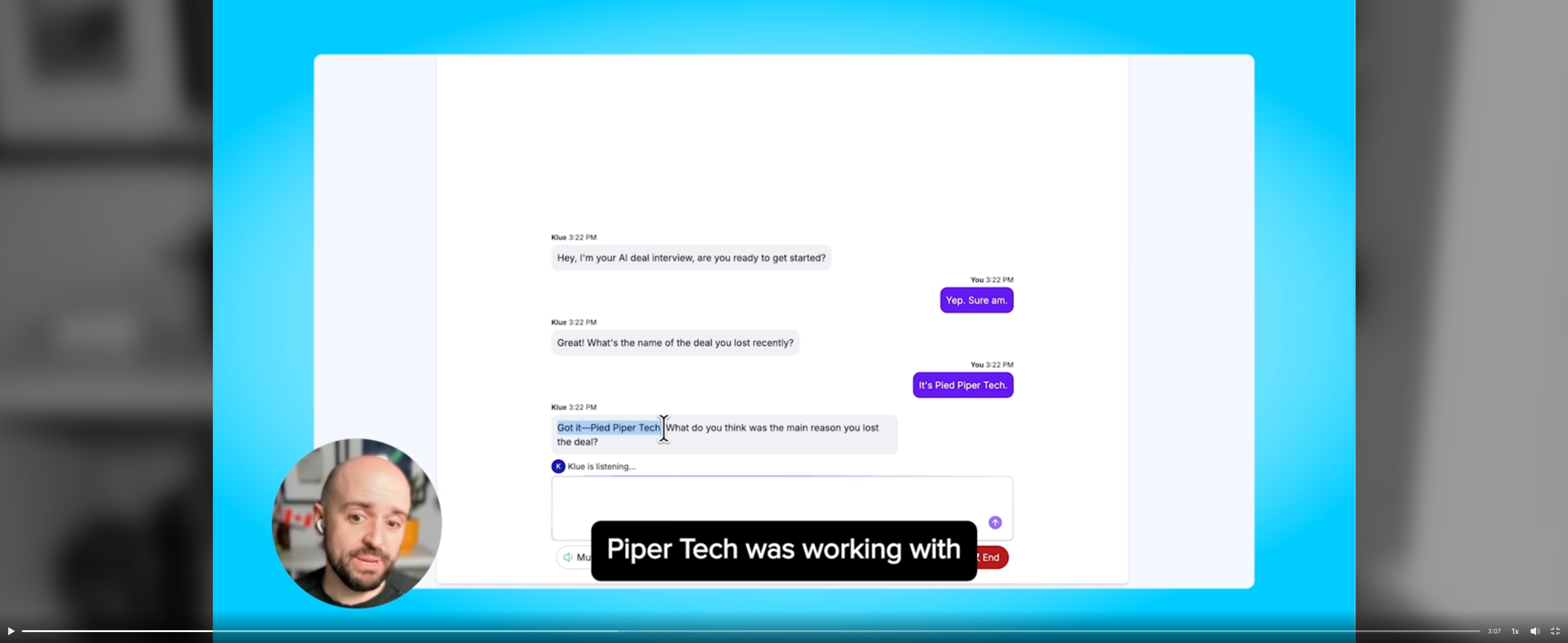
We've done more buyer interviews this month than Klue has done in the last year. There's a reason for that: sellers aren't buyers, and a chat prompt isn't an interview.
On deal-level insights: Klue integrates with Gong and your CRM, but the integration mostly reads data back to you. If your reps aren't logging calls accurately, or your CRM fields are incomplete, Klue's "insights" reflect those same gaps. There's no analysis layer that corrects inaccurate data or extracts patterns across your deal history. You get what you put in — which is exactly the problem most teams are trying to solve.
Because the win-loss data lives separately from the battlecards and competitive monitoring, the insights don't feed back into the content your reps actually use. It isn't tightly integrated.
Best for
Teams that need a managed CI workflow focused on competitor monitoring and battlecard distribution. Organizations that aren't yet running a win-loss program and aren't concerned about deal-level analysis.
Who should choose what
Choose Hindsight if
- You want CI and win-loss in one platform
- You want battlecards built from what actually won and lost deals
- You need 100% deal coverage, not a sampled win-loss program
- You are building AI workflows on verified competitive intel
- You want external monitoring plus internal deal analysis
Choose Klue if
- You want a managed CI workflow focused on external signals
- You do not have a win-loss program and want occasional analyst-led research
- Battlecard distribution and sales team adoption tools are your primary need
- You are not yet running deal-level analysis
The bottom line
Klue was built for a world where monitoring competitor websites was hard. That world is gone. Any team with an LLM can do that for free today.
The intelligence that moves win rates isn't available on any competitor's website. It isn't in your Gong transcripts either — not because the data isn't there, but because assuming your reps already have the best messaging and are conveying it perfectly is exactly the assumption you're trying to test. Insight that comes back from your own Gong calls tells you what your reps said. It doesn't tell you what your buyers decided, or why.
Good buyer interviews at scale. Quality insights that improve with every deal. That's what drives win rate improvement. That's what reps actually benefit from. That's what Hindsight is built for.
Hindsight gives you both sides of the picture. Klue gives you the half that's free.
"Used by LaunchDarkly to close 12% more competitive deals."
Frequently asked questions
Does Hindsight replace Klue entirely?
For most teams, yes. Hindsight monitors competitor activity across the web, G2, news, and job postings, and adds deal-level analysis that Klue does not have. If your primary need is battlecard distribution tooling and sales adoption features, evaluate both. If your primary need is competitive intelligence that actually reflects why you win and lose, Hindsight covers it.
How are Hindsight's battlecards different from Klue's?
Klue's battlecards are built from web monitoring and Gong call quotes. They tell you what competitors say about themselves and what came up in conversations. Hindsight's battlecards are built from verified deal outcomes. What messaging worked in the last 30 competitive wins. What objections came up in losses. What the buyer actually said drove the decision. One tells you what competitors say. The other tells you what beats them.
Does Hindsight do web monitoring like Klue?
Yes. Hindsight monitors competitor websites, G2, news, and job postings. It also layers in deal-level analysis that no external monitoring tool can provide.
What about Klue's win-loss interviews?
Klue does have a win-loss interview feature, but it surveys sellers via a basic chat interface — not buyers. It has no deal context, so reps are asked to re-enter information that already exists in their CRM. It's inconvenient, doesn't actually help reps, and produces the rep's narrative rather than verified buyer feedback. Hindsight interviews buyers directly, with full deal context, automatically after every close. We've done more buyer interviews this month than Klue has done in the last year.
Is public competitor data still worth tracking?
Yes, as context. Knowing when a competitor launches a new feature or changes their pricing is useful. The problem is that every team has access to the same public data — and with LLMs, that monitoring is essentially free. It does not give you an edge. Your deal data does. What your buyers said about that competitor's new feature in actual evaluations is what matters. Hindsight gives you both.
Does Klue analyze deal data from Gong and CRM?
Klue integrates with Gong and CRM, but the integration primarily reads data back rather than analyzing it. If your reps aren't logging calls accurately, or your CRM fields are incomplete, those same gaps appear in Klue's output. There's no layer that corrects inaccurate data or builds patterns across your deal history. Hindsight validates CRM inputs against actual deal activity and has identified a +44% improvement in loss reason accuracy for customers.